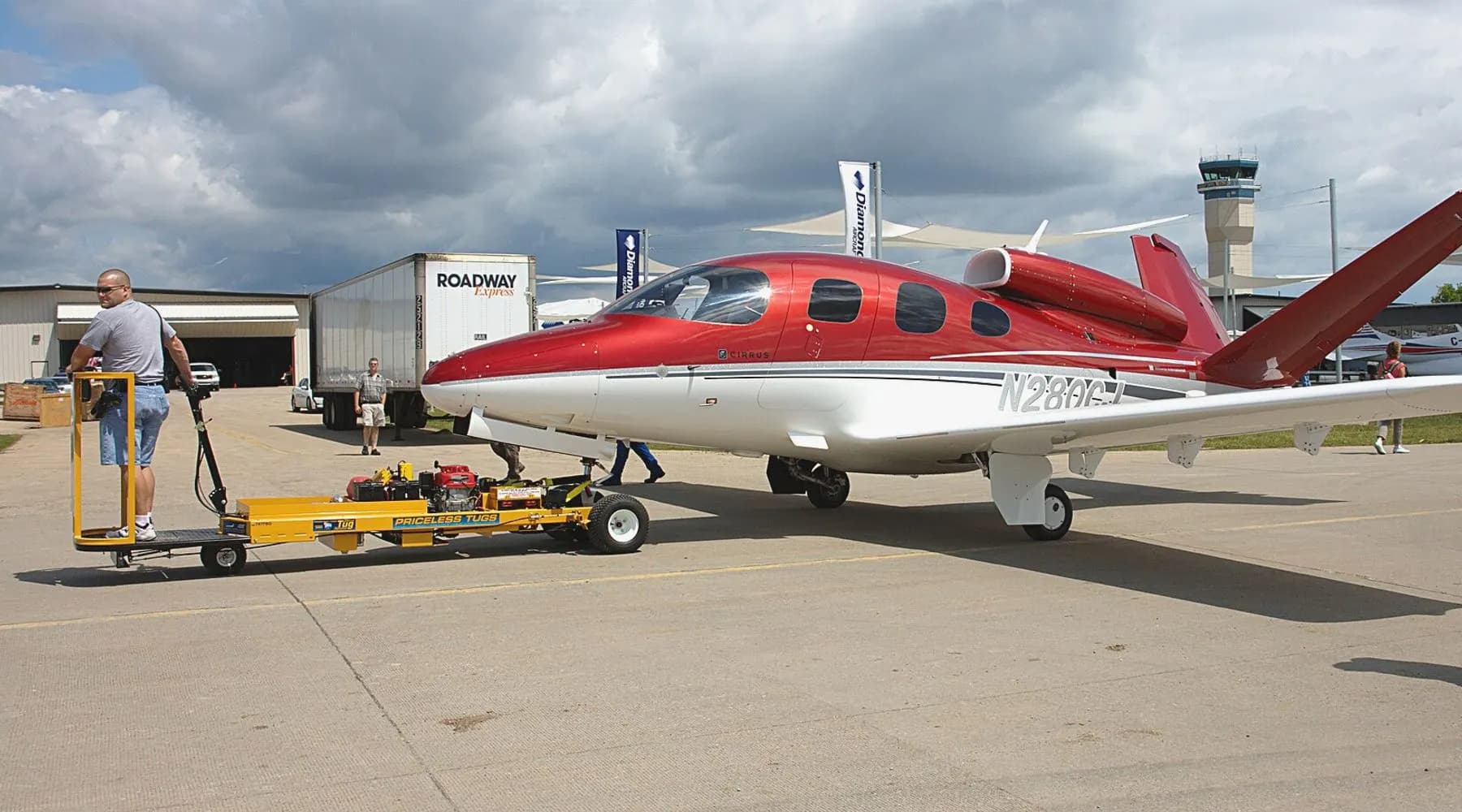
Cirrus Aircraft SF50 · G2+ / G7+
One engine. One pilot. One category of its own.
The Vision Jet is the only single-engine personal jet in production — and the only civilian jet ever certified with a whole-airframe parachute.
- Max cruise
- 311 KTAS
- Max range
- 1,275 nm
- Ceiling
- FL310
- Seats
- Four in charter
The Vision Jet exists because Cirrus asked a question the rest of the industry had stopped asking: what would a jet look like if it were designed around the person flying it rather than around the flight department buying it? The answer was a single engine mounted above the fuselage, a V-tail, a cabin with windows sized for looking out of, and a parachute over the whole airframe.
It took Cirrus longer than anyone expected to certify — the type achieved FAA certification in 2016 after more than a decade of development — and the result has been the best-selling jet in its category every year since. That is not a marketing claim about desirability. It is a statement about what happens when an aircraft matches a real mission rather than a spreadsheet.
The mission is 300 to 800 nautical miles with four people aboard, into an airport near where you actually want to be. That covers the overwhelming majority of private flying. Larger jets do it faster and cost several times as much to do it; turboprops do it slower and lower, in air that is rougher and considerably louder.
Halcyon quotes this type exclusively. Not because it is the best aircraft ever built, but because it is unambiguously the right aircraft for a regional pair inside 600 nautical miles — and because a broker who looks at one airframe all day knows things about it that a broker looking at forty cannot.
Specifications
The numbers
- Passengers
- Four, as sold
- Max Cruise Speed
- 311 KTAS
- Max Range
- 1,275 nm
- Service Ceiling
- FL310
- Typical Cruise
- FL280
- Balanced Field
- 3,192 ft
- Landing Distance
- 2,346 ft
- Baggage Volume
- 32 cu ft
- Engine
- Williams FJ33-5A
- Avionics
- Perspective Touch+ by Garmin
Safety
Two systems no competitor offers
Not features. Certified systems that change the outcome of the scenarios people are actually afraid of.
CAPS — Cirrus Airframe Parachute System
A ballistic parachute for the entire aircraft, not the occupants.
Safe Return Emergency Autoland
A passenger can land the aircraft by pressing one button.
Perspective Touch+ by Garmin
Envelope protection, autothrottle, and synthetic vision as standard.
FIKI-Certified Known Ice Protection
Certified for flight into known icing, not merely equipped for it.
Cabin
What it is like to sit in
Five seats that are actually usable
Four seats in charter configuration, in a cabin 61 inches wide and 49 inches high. It is not a stand-up cabin and Cirrus has never pretended otherwise. It is wider than a Citation M2's and considerably brighter, with the largest windows in the class.
Thirty-two cubic feet of baggage
Sample cases, displays, laptops, and non-hazardous tooling travel with no per-bag fee and no airline size template. Weight remains a real constraint on longer legs, which we plan honestly rather than discovering at the ramp.
Quiet where it matters
The engine sits above and behind the cabin rather than beside it. On a turboprop the propeller's plane of rotation passes directly next to the passenger seats; here it does not, and the difference over a two-hour leg is substantial.
Pressurised to FL310
A service ceiling of 31,000 feet puts the aircraft above most weather and most traffic. The typical cruise of FL280 is smoother air than anything a piston or most turboprops can reach.
Head to head
How it compares
Honest comparisons, including where the other aircraft is the better answer. A comparison that never concedes anything is not a comparison.
- Vision Jet vs
Embraer Phenom 100
Twin-engine very light jet
- Vision Jet vs
Cessna Citation M2
Twin-engine light jet
- Vision Jet vs
HondaJet HA-420 / Elite II
Twin-engine very light jet
- Vision Jet vs
Pilatus PC-12
Single-engine turboprop
- Vision Jet vs
Beechcraft King Air 350i
Twin-engine turboprop
- Vision Jet vs
A First-Class Airline Ticket
Scheduled commercial service
Fly it
The specifications matter less than the trip. Tell us where you are going and we will tell you what it costs.